Patient Information

Achilles tendinopathy
Print this page

Information in this booklet is intended to be used as a guide. It gives you an idea about how Achilles tendinopathy is managed.
You should remember that every case is different, and symptoms can vary from person to person.
The Achilles tendon connects the calf muscles to the heel bone and helps you to push up on your tiptoes. Overuse of this tendon can result in inflammation and irritation in the tendon; this is known as Achilles tendinopathy.
The main symptoms include pain, stiffness and swelling of the back of the heel. These symptoms are often worse in the morning.
The treatment includes exercises to strengthen and stretch the calf muscle, and adapting activities to allow symptoms to ease.
With the right exercises, most cases will settle in three to six months. Occasionally if the symptoms have been present for some time, it may take up to a year to improve.
If all the appropriate exercises have been completed regularly and symptoms last more than one year, then other options may be considered by a consultants, for example, platelet rich plasma injections (PRP) or surgery, which is the last resort.
What is Achilles tendinopathy?
Achilles tendinopathy is a condition affecting the Achilles tendon, most commonly due to it being overloaded. The tendon is unable to cope with the load being applied to it and can become thickened and painful.
You may have heard it being referred to as tendinosis or tendinitis in the past, but now the preferred name is tendinopathy.
It usually affects the tendon where it meets the heel bone.
Insertional tendinopathy is found where the tendon meets the heel bone.
Mid-portion tendinopathy is the most common; found within the body of the tendon.
Why me?
The causes of Achilles tendinopathy are not fully understood, but there are risk factors that can contribute to you developing it, including:
Being overweight.
Tight or weak calf or hamstring muscles.
Stiff or previously injured ankle joints.
Sudden, large increases in activity levels, for example, running, walking, playing sports.
Training errors, including a lack of variety in training, or too much hill running.
Having underlying conditions such as diabetes, high cholesterol and blood pressure.
Recent use of ‘Fluroquinolone’ antibiotics.
Age (over 30).
Gender (males more than females).
Family history of Achilles tendinopathy.
If you have rheumatoid arthritis or an inflammatory joint disease such as psoriatic arthritis.
Ongoing physical or mental health problems can contribute to the symptoms.
Symptoms
The typical symptoms include pain, stiffness and swelling around the back of the heel.
Pain is often present first thing in the morning or when you begin to walk after resting for a time. The pain can be variable, and it can improve as you keep moving.
You may notice it can be painful after lots of weight-bearing activities, such as walking or running.
In some cases, the tendon may become red, warm, tender to touch and swollen or thickened in appearance.
Is it serious?
No. There is a small chance (of approximately 4% of patients) who may go on to rupture their tendon; being over 50 can slightly increase the chances of this. Doing strengthening exercises will not increase the risk of rupture.
A rupture may present as:
The sudden feeling of having been kicked hard in the calf.
New pain, possibly severe, and swelling near the heel.
Being unable to bend the foot downward or ‘push off’ the injured foot when walking.
If this happens, you should seek urgent medical attention at an Emergency Department (A&E).
Diagnosis and investigations
Achilles tendinopathy is diagnosed from the signs and symptoms that you describe. Assessment of the foot, ankle and lower legs by a healthcare professional may help to inform this diagnosis. If the diagnosis is unclear, then an ultrasound scan can be performed to aid the diagnosis.
Sometimes an ankle x-ray may be indicated, but this tends to be more for insertional tendinopathies that are not improving with exercises and therefore may benefit from surgery.
If underlying health conditions are suspected, such as diabetes or high cholesterol, then blood tests to check or monitor these conditions may be needed.
Will it get better?
Yes, the average time to improve is is 12 weeks or longer, but if you have had symptoms for several months it may take longer, possibly up to one year.
Only a small number do not improve with exercises. This is often if the symptoms have not been managed at the early stages and so the tendon becomes more resistant to change.
Management
To reduce pain, especially in the early painful and swollen stages, the following may help:
Relative rest and altered training regime: Reduce activities on your feet, such as prolonged walking or running. However, continue to maintain your fitness by doing other forms of exercise, such as cycling or swimming.
Painkillers - discuss simple medication such as paracetamol or non-steroidal anti-inflammatories with your GP or pharmacist. Sometimes anti- inflammatory gels can also be helpful.
Ice - apply ice for 10-15 minutes, wrapped in a damp towel. Please remove if it feels like it is burning to prevent ice burns from occurring.
Footwear - choosing supportive footwear with a small, broad heel, rather than flat shoes, can help relieve pain. Please check that they do not rub on the painful, swollen area.
Weight loss - losing weight will help to take some of the load off the plantar fascia (the strong band of tissue that runs along the underside of your foot), making your foot less irritated. This can reduce the stress on the Achilles, making it less painful. You should aim to have a body mass index (BMI) of 25 or less. This can be very useful in improving your symptoms.
Physiotherapy - strengthening exercises for the tendon.
Insoles - also known as orthotics. You can buy various pads and insoles to cushion your heel and/or support the arch in your foot. Your physiotherapist can advise you about this. The most important thing is that they are comfortable to wear in your shoes. Both firm and soft insoles have been shown to be useful.
Managing any underlying causes, such as blood sugar levels.
Treatments
Physiotherapy
Physiotherapy offers advice and guidance, which helps you to understand your condition. In addition, an exercise programme, that is personal to you and your needs will be prescribed.
Achilles tendinopathy is related to the tendon’s ability to cope with the load you put through it. Exercises which specifically strengthen this tendon will enable healing and help you return to normal activity. Please see the exercise section later in the booklet for you to complete in the early and later stages of rehabilitation. Your physiotherapist may identify these and other specific exercises for you to complete. You will need to follow these instructions and monitor your performance of these carefully. Exercises specific to the tendon are needed to help recovery but overloading the tendon may worsen the pain.
Steroid injections
These are sometimes used to help with physiotherapy exercises. However, for Achilles tendinopathy they are avoided due to the risk of rupture. Occasionally, ‘high volume’ saline injections (injections of saline and anaesthetic) around the tendon are trialled, aiming to reduce the inflammation and irritation around the tendon.
Platelet rich plasma (PRP) injections
PRP is a treatment where blood plasma containing concentrated platelets is injected into the Achilles to help repair the affected tissue. It has been shown to help speed up the healing process, but its long-term effectiveness is unknown. You would need to be referred to Orthopaedics to discuss if this treatment is appropriate for you.
Surgery
Most cases will resolve with conservative (non-surgical) management. However, should the problem persist, surgery may be indicated but this is rare. There are potential complications from surgery, and recovery takes months. For this reason, surgery is only considered if the symptoms have not improved after 12 months of appropriate conservative (non-surgical) treatment.
Exercises
The exercises are designed to rebuild the strength of the tendon. Some exercises are for the early stages of your treatment, while others are for later stages, when the tendon becomes more able to cope.
The exercises may cause some mild discomfort, which should be manageable and settle within 24 hours. If the discomfort fails to subside after 24 hours, simply reduce the repetitions or weight.
Calf stretches
Calf stretches (gastrocnemius and soleus) help as they reduce the tightness across the tendon.
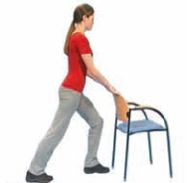
Standing behind a chair for support, stretch the leg to be exercised straight behind you while keeping your other leg bent in front of you.
Keeping both feet flat on the floor, lean your body forwards and down slightly (as if pushing into the floor) until you feel a stretch in the calf of your back leg.
Hold the position for approximately 20 seconds and then relax.
Repeat the above three times.
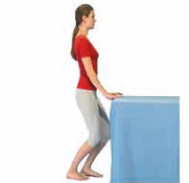
Standing behind a chair or table for support (if needed), put the leg to be exercised slight behind the other leg.
Push your heel down while bending the knee to stretch the Achilles tendon.
Hold the position for approximately 20 seconds and then relax.
Repeat the above three times.
Loading programme for early stages or warm-up exercises
Aim to do the exercise every day, one to two times a day. Start with the highest number of repetitions you can manage – often 10 to 15 – and if this goes well with minimal discomfort, increase the sets of repetitions to what you can manage, from one to three.
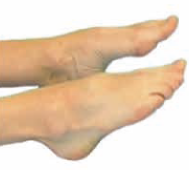
Lying on your back or sitting, bend and straighten your ankles.
Keep your knees straight to ensure you stretch your calf muscles.
Repeat the above 15 times.
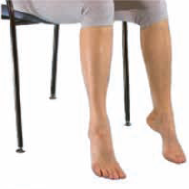
While seated, lift your heels off the floor and then lower.
Repeat the above 15 times.
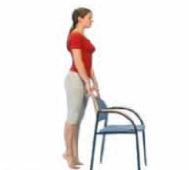
Standing behind a chair for support, push up on your toes and then lower.
Repeat the above 15 times.
If this exercise becomes easy, progress to just one leg (your sore leg).
Loading programme for middle and late stages
As the pain eases and you can manage the earlier stage exercises, progress to the following exercises. The exercises can be done in two parts:
Part 1 - keep the knees straight.
Part 2 - bend the knees slightly during the exercise.
Aim for 15 repetitions - three sets daily.
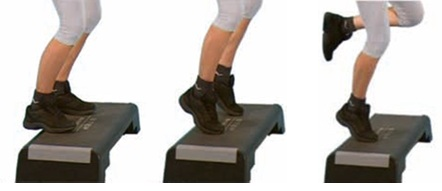
Standing on the edge of a step, lift your heels so you’re on your tiptoes.
Lift your good leg off the step and slowly lower the heel of your other (sore) leg to the same level as the step.
If you are managing the above and the pain is in the mid-tendon, aim to drop the heel below the level of the step.
Progressing this exercise further:
Drop your heel below the level of the step.
Increase the speed of movement.
Add weights.
Lift and lower your sore leg only.
If you usually run, you can start to gradually increase your running at this stage as the tendon becomes stronger and your pain should be easing.
Your Health Notts
It is always important to consider other factors that can contribute to musculoskeletal problems and may limit your recovery. The most common factors that can affect your health and wellbeing include smoking, alcohol, weight, stress and general fitness.
There is an excellent resource now available to Nottinghamshire County residents that offers information and guidance on:
- Stopping smoking
- Losing weight
- Alcohol reduction
- Increasing physical activity.
Please visit the Your Health Notts website to find out more or self-refer to this service.
Further sources of information
This document is intended for information purposes only and should not replace advice that your relevant health professional would give you.
External websites may be referred to in specific cases. Any external websites are provided for your information and convenience. We cannot accept responsibility for the information found on them.
Patient Experience Team
The Patient Experience Team (PET) is available to help with any of your compliments, concerns or complaints, and will ensure a prompt and efficient service.
Contact Patient Experience.
Approved
October 2025
Review date
October 2027
Document Id
PIL202510-01-AT
Service / Department
Musculoskeletal (MSK)
Other formats
Patients who would like this information in an alternative format, or need help communicating with us, please contact our patient experience team.