Patient Information

Anterior knee pain
Print this page

Information in this booklet is intended to be used as a guide. It gives you an idea about how anterior knee pain can be managed.
However, you should remember that every case is different, and symptoms and management can vary from person to person.
Also known as runner’s knee or patello-femoral pain syndrome.
Anterior knee pain is a term used to describe pain at the front of the knee and is often referred to as an overuse injury.
It can be caused by several factors that contribute to increased load on the knee. An increase in running or walking distance or intensity, prolonged kneeling, inappropriate footwear or increased weight gain can all contribute to symptoms. Techniques such as exercises, ice, heat, medication and activity modification, can help you to manage your symptoms.
What is anterior knee pain?
This is a term used to describe pain at the front of the knee. There are a variety of conditions that could be causing your knee pain, such as patella tendinopathy, bursitis or fat pad irritation.
The condition can normally be diagnosed by your reported symptoms and an assessment completed by your healthcare professional. Further investigations are often not needed. If the diagnosis is unclear, then an x-ray or ultrasound may be performed to aid the diagnosis.
Why me?
Anterior knee pain is the most common condition that affects the knee. It is thought to affect 25% of the population at some point in their life.
Risk factors include:
Sudden increase in running, walking or standing when you are not used to it.
Lack of muscle strength.
Lack of muscle flexibility.
Lack of muscle control.
Wearing shoes with poor cushioning, little support or heels.
Sudden gain in weight, or if you are overweight.
Previous injury to the knee.
Symptoms can develop gradually or follow from an injury. However, sometimes there may be no clear cause of the pain.
Symptoms
As anterior knee pain can include a few different conditions, the symptoms may vary. Anterior refers to the front of the knee. Pain is often the main symptom reported by patients. They can range from very mild to more intense symptoms and can include:
Dull ache or sharp twinges at the front of the knee.
Occasional swelling around the front of the knee.
Feeling of painful locking at the front of the knee.
Feeling of weakness or giving way (especially when going downstairs or hills).
Clicking or grating noises at the front of the knee.
Symptoms may be worse with the following:
Walking downhill or downstairs.
Kneeling.
Sitting for long periods of time.
Sporting activities.
If anterior knee pain is left untreated, it may become a chronic condition. It is thought to be the leading cause of chronic knee pain in young people.
Diagnosis and investigations
Anterior knee pain is diagnosed from the signs and symptoms that you describe. Assessment of the knee and lower legs by a healthcare professional may help to inform this diagnosis. If the diagnosis is unclear, then an x-ray or ultrasound may be performed to aid the diagnosis.
Will it get better?
Your symptoms can often be managed with advice and exercises from your treating clinician. Most cases will usually improve within three to 12 months of treatment.
Treatment is aimed at:
Reducing pain and inflammation and promoting healing.
Restoring flexibility and normal movement.
Improving strength and normalising function.
We work with a team of advanced clinical practitioners and orthopaedic consultants who can review your case if symptoms do not improve within an expected period of time.
Most patients with anterior knee pain have a positive outcome with adherence to physiotherapy. A small number of patients may be considered for steroid injections. Injections are only offered in conjunction with physiotherapy.
Surgery for anterior knee pain is rare.
Management
Anterior knee pain is treated with a variety of different management techniques. Below is a list of ways you can help yourself:
Rest - anterior knee pain in general is an overuse injury, so try to reduce, where possible, any activity that is aggravating the knee.
Strength - your physiotherapist can provide you with exercises to help strengthen your legs (knees, hips and feet). It is important that these exercises are performed relatively pain-free (discomfort is expected) and achieve an element of fatigue.
Ice / heat - you can use one or both of these for your knee to help symptoms. The choice is up to each individual to decide which works best for you.
Activity - you may need to modify or stop any activities that produce anterior knee pains in the short term and are able to gradually return to full activity as your pain improves.
Other factors - try to identify any changes in your lifestyle, either internal (such as weight gain) or external (such as different footwear) and consider if they started with the onset of your problem. If so, try reversing this to see what effect it has on your pain.
In general, anterior knee pain is an overuse injury so try to vary the stresses you apply to your knee.
For example, if you are a runner mix it up, so you’re not always doing hill work.
Keep the muscles in your legs as flexible as possible by regular stretching.
Keep the muscles in your legs in good condition by regular exercises.
Wear well-fitting appropriate footwear especially when doing sporting activities such as running.
Good tips:
- Avoid sitting for a period of time where you knee is in a bent position.
- Use a handrail to help you up and down stairs, one step at a time, if needed.
- Temporarily avoid kneeling / sitting back on heels.
- Temporarily avoid prolonged wearing of high heel shoes.
- Avoid riding a bike with a low seat.
Controlling your pain allows you to continue to function and carry out your daily activities more comfortably.
Your GP may have already discussed medication to help with your pain and the correct ways to take pain relief. They may recommend that you take it as a short course rather than ‘as and when’ the pain is bad. This often includes paracetamol, co-codamol (Zapain), and non-steroidal anti-inflammatory medication such as ibuprofen. Please always read the instructions before using these products.
If your day involves long periods of walking or standing, ensure you change position and take breaks regularly.
If your job involves prolonged sitting, ensure that you keep your knees moving by bending and straightening your knees at your desk.
If you are sitting on public transport or at the cinema, you may feel more comfortable if you choose an aisle seat so you can stretch your knee and stand up occasionally.
If kneeling is involved, use kneepads or a cushion to reduce the pressure through your knees and try to limit kneeling or squatting for long periods by standing occasionally.
Make a gradual return to running when your knee pain has settled, and you can walk pain-free. Do not be in a hurry to do this, as it may increase your symptoms if you do too much too soon.
Warm up and stretch gently before and after training.
If possible, start your running on a treadmill (on a slight incline).
Running on uneven or hard ground may aggravate your symptoms. Find a surface that is comfortable for you.
Gradually increase your jogging distance. Initially, do interval jogging, such as walk, jog, walk, jog. Your health care professional may advise what distance these jog sections should be.
If you reach the point where you are comfortable jogging for 30 minutes and want to increase this time further, you may want to vary the speed or try intervals before increasing the distance further. This will help your knee become conditioned to different loads to try and prevent a recurrence of symptoms.
Slowly introduce hill training if appropriate. Don’t do hill running early on.
If your sport involves changes in direction or running around bends, once you can jog comfortably for 30 minutes, introduce a change of direction, such as slow jogging in zigzags, round cones, or figure of 8s.
Other fitness training, such as swimming, cycling, rowing, stepper or cross trainer can also help.
Exercises
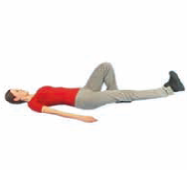
Lie on your back and bend one leg at the knee
Try to lift the straight leg off the floor by approximately one to three inches.
Hold for a slow count of five, then lower in a controlled manner.
Repeat five times with each leg, gradually building up to 15.
Complete at least twice per day.
If you are unable to get on the floor, you can do it on your bed.
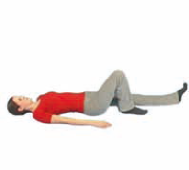
Complete this exercise if range of movement or stiffness is an issue:
Lie on your back.
Bend and straighten your affected knee.
Repeat five to ten times with each leg.
Complete at least twice per day.
If you are unable to get on the floor, you can do it on your bed.
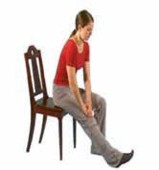
Sit on a chair with your leg straight in front of you.
Place your hands on your thigh just above your kneecap.
Keeping your back straight, lean forward over the straight leg.
Use your hand to assist with the stretch of your knee.
Hold for 20 to 30 seconds.
Repeat three times in one go.
Repeat two to three times per day.
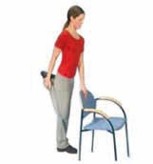
Stand holding on to a support with one hand and with the other hand hold onto the ankle.
Pull the ankle towards your bottom.
Keep your knees together and push your hip/pelvis forward.
Hold for 20 to 30 seconds.
Repeat three times in one go.
Repeat two to three times per day.
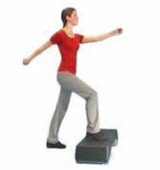
Stand in front of a 20 to 40 cm step.
Only using one leg, step up and slowly lower down.
This exercise must be done with control, making sure your thigh does not wobble and your kneecap stays facing forward.
Repeat with the other leg leading.
Hold for 20 to 30 seconds.
Repeat three times in one go.
Repeat two to three times per day.
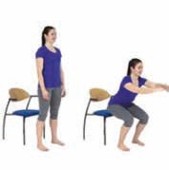
Stand tall in front of a chair.
Squat down as if you were sitting down, sticking your bottom out.
Briefly touch the chair with your bottom and then stand back up (squeezing through your bottom).
Make sure you maintain the gap between your knees all the way through.
Repeat five to 15 times.
Repeat two to three times per day.
Your Health Notts
It is always important to consider other factors that can contribute to musculoskeletal problems and may limit your recovery. The most common factors that can affect your health and wellbeing include smoking, alcohol, weight, stress and general fitness.
There is an excellent resource now available to Nottinghamshire County residents that offers information and guidance on:
- Stopping smoking
- Losing weight
- Alcohol reduction
- Increasing physical activity.
Please visit the Your Health Notts website to find out more or self-refer to this service.
Further sources of information
This document is intended for information purposes only and should not replace advice that your relevant health professional would give you.
External websites may be referred to in specific cases. Any external websites are provided for your information and convenience. We cannot accept responsibility for the information found on them.
Patient Experience Team
The Patient Experience Team (PET) is available to help with any of your compliments, concerns or complaints, and will ensure a prompt and efficient service.
Contact Patient Experience.
Approved
October 2025
Review date
October 2027
Document Id
PIL202510-01-AKP
Service / Department
Musculoskeletal (MSK)
Other formats
Patients who would like this information in an alternative format, or need help communicating with us, please contact our patient experience team.