Patient Information

Carpal tunnel syndrome
Print this page
Information in this booklet is intended to be used as a guide. It gives you an idea about how carpal tunnel syndrome can be managed.
You should remember that every case is different, and symptoms and management can vary from person to person.
Carpal tunnel syndrome is a common condition where the nerve becomes compressed, restricted or irritated where it passes through the wrist. It can usually be diagnosed following an examination by a healthcare professional.
Symptoms tend to be worse at night and may disturb your sleep. You may be getting pain, aching, tingling or numbness in the affected hand. Symptoms are usually worse in the thumb, index and middle fingers.
The good news is that treatment is usually successful and when treated early, very few people are left with long-term hand problems.
Some cases improve without treatment, but treatments are usually very effective. They can include exercises, a splint and a steroid injection. Sometimes an operation is needed if your symptoms persist, or if your hand is very weak.
Do not worry if you do not see improvements straight away. Remember, time is often a very important factor. Carpal tunnel syndrome usually resolves with treatment.
What is carpal tunnel syndrome?
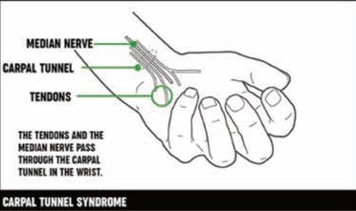
Carpal tunnel syndrome is a common condition where the nerve becomes compressed, restricted or irritated as it passes through the wrist.
This nerve, called the median nerve, controls muscles that move your thumb.
It also carries information back to the brain about sensations in your thumb and fingers.
The good news is that treatment is usually successful and when treated early, very few people are left with long-term hand problems.
Why me?
In most people there is not an obvious cause. However, possible causes include:
Activities that place a higher demand on the wrist, such as using vibrating tools.
Obesity.
Diabetes.
Hormonal changes.
An underactive thyroid gland.
Any form of arthritis affecting the wrist.
Stress or feeling low in mood.
Symptoms
Symptoms tend to be worse at night and may disturb your sleep. They can include:
Pain, aching, tingling or numbness in the affected hand.
Symptoms in the thumb, index and middle fingers (although sometimes it can feel like your whole hand is affected).
An ache in your forearm, arm or shoulder.
Diagnosis and investigations
This is diagnosed from the signs and symptoms that you describe.
Assessment of the wrist, hand, elbow and neck by a healthcare professional may help to inform this diagnosis.
If the diagnosis is unclear, then an MRI of the neck or nerve conduction studies can be requested to aid the diagnosis. These further investigations are often not required.
The assessment often includes:
Looking for muscle wasting around the thumb.
Tapping over the wrist.
Holding the wrist in a bent / compressed position.
Testing the strength of the muscles.
Looking at your neck movements.
Assessing the sensation of the skin.
Will it get better?
Your symptoms can often be managed with advice and exercises from the physiotherapist. Most cases will resolve with conservative (non-surgical) treatment within three to six months.
We work with a team of advanced clinical practitioners and orthopaedic consultants who can review your case if symptoms do not improve within an expected period.
Steroid injections are sometimes used to facilitate physiotherapy exercises. Injections are only offered alongside physiotherapy.
Management
Your healthcare professional will talk to you about the different treatments available and help you decide which would be best for you.
If the condition is severe and you have wastage within your hand muscles, then it’s important to get treatment quickly, and you’ll normally be advised to have surgery.
Some cases improve without treatment. However, if treatments are needed, they are usually very effective.
They can include:
Exercises - details further down.
Splints - splint to be worn at night.
Steroid injections - to reduce inflammation.
Surgery - carpal tunnel release surgery if your symptoms persist despite treatment, or if your hands are weak.
Other - treating a cause such as diabetes.
Myelopathy is a rare condition where the spinal cord gets compressed. If you have, or start to get, any of the symptoms listed below, you should seek urgent medical attention at your nearest Emergency Department (A&E):
Problems going to the toilet including a new feeling of wanting to empty the bladder but being unable to, continuation of emptying your bladder when you thought you had finished or, incontinence of bladder or bowels.
Tingling or numbness in your genitals, back passage or upper, inner thighs.
Large reduction in strength and/or coordination of arms and hands.
New or unexplained balance or unsteadiness.
Splints
A splint will be provided. These are only to be used at night. This is to keep the wrist in a neutral position to reduce the compression to the nerve, while you sleep.
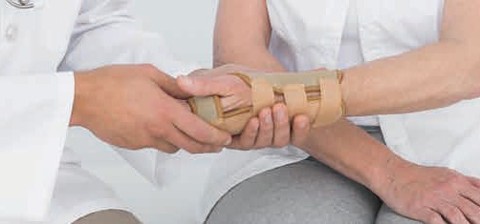
Here are some tips for wearing the splint(s):
When fitting your splint, the metal bar should be over the palm of your hand.
The straps at the back should fit like the picture above.
The splint should only be worn at night - not during the day.
You can start wearing the splint at night. Try to build the length of time the splint is worn until you can manage the whole night.
Ensure that it is not too tight.
Do not drive in your splint.
Check your skin to ensure no red areas or skin breakdown. If you are concerned, remove the splint. You can also use an old sock with a cut-out to wear under the splint to stop any irritation.
Initially, use the splints for six weeks to see if it settles your symptoms. It is also advised that you continue to use the splints for up to three months after your symptoms improve or resolve.
Medication for pain control
Medications such as paracetamol and non-steroidal anti-inflammatory medication, such as ibuprofen, are often not helpful. A steroid injection may be helpful. A small quantity of steroid is injected into the carpal tunnel, which helps to reduce the swelling and inflammation. The injection can be uncomfortable, but it can be very effective.
If the irritation to the nerve is being caused by osteoarthritis of the wrist joint, a steroid injection directly into the wrist joint may help.
Sometimes the effects of the injection may only be temporary, lasting weeks or months. If this happens, your healthcare professional will discuss other options.
Surgery
If your symptoms do not respond to treatment or there is severe compression, you may need surgery. Carpal tunnel release surgery relieves pain by reducing the pressure on the median nerve.
Surgery usually takes place as a day case, and you can expect to recover in less than a month. The operation is normally carried out under a local anaesthetic and usually leaves only a small scar. Most patients report a good outcome/result following surgery.
Work
If you think your work may be causing your symptoms, you should discuss this with your supervisor or an occupational health professional. They may be able to advise you on changes to your equipment or working techniques.
Stress
There is a link between stress, anxiety and depression and ongoing pain, so you may find it useful to address these if they affect you. Research shows exercise, sleep and relaxation strategies help to reduce stress.
The NHS website or your GP surgery can signpost you to information that you may find helpful.
Do not worry if you do not see improvements straight away - remember time is often a very important factor. Carpal tunnel syndrome usually resolves with treatment.
Exercises
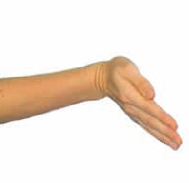
Rest your elbow on a table with your arm pointing up and keeping your wrist straight.
Gently bend your wrist forward at a right angle and hold for five seconds.
Straighten your wrist back to the starting position.
Gently bend your wrist backwards and hold for five seconds.
Repeat the above 10 times for a total of three sets.

Start with your fingers held out straight.
Gently bend the middle joints of your fingers down toward your upper palm.
Hold for five seconds before straightening your fingers out.
Repeat the above 10 times for a total of three sets.
Your Health Notts
It is always important to consider other factors that can contribute to musculoskeletal problems and may limit your recovery. The most common factors that can affect your health and wellbeing include smoking, alcohol, weight, stress and general fitness.
There is an excellent resource now available to Nottinghamshire County residents that offers information and guidance on:
- Stopping smoking
- Losing weight
- Alcohol reduction
- Increasing physical activity.
Please visit the Your Health Notts website to find out more or self-refer to this service.
Further sources of information
This document is intended for information purposes only and should not replace advice that your relevant health professional would give you.
External websites may be referred to in specific cases. Any external websites are provided for your information and convenience. We cannot accept responsibility for the information found on them.
Patient Experience Team
The Patient Experience Team (PET) is available to help with any of your compliments, concerns or complaints, and will ensure a prompt and efficient service.
Contact Patient Experience.
Approved
October 2025
Review date
October 2027
Document Id
PIL202510-01-CTS
Service / Department
Musculoskeletal (MSK)
Other formats
Patients who would like this information in an alternative format, or need help communicating with us, please contact our patient experience team.