Patient Information

Heel pain (plantar fasciitis)
Print this page
Information in this booklet is intended to be used as a guide. It gives you an idea about how heel and foot pain can be managed.
You should remember that every case is different, and symptoms and management can vary from person to person.
Plantar heel pain, sometimes known as plantar fasciitis, is typically pain under your heel and sole of your foot.
It is often caused by sudden increase in load of the foot by doing more standing, walking or physical activity than your foot is used to. It can also occur when your weight has increased and the foot has not yet adapted to this new load.
Plantar heel pain can also be caused by your plantar fascia, and its ability to handle increased load, over time. There are many things you can try and do to help your pain and symptoms that have been shown to be effective. However, for some patients, symptoms can be stubborn, and it can take time to respond and improve.
What is heel and foot pain?
The plantar fascia is a strong fibrous band of tissue that runs under the foot. It connects the heel bone to the bones of the toes and supports the arch of the foot.
Most cases of heel pain are caused when the plantar fascia becomes inflamed, irritated and thickened. This can cause plantar heel pain.
Plantar fasciitis, plantar fasciopathy and plantar heel pain are all terms that are used to describe pain around the heel and foot. They are words used to describe inflammation, irritation and thickening of the plantar fascia.
It is often caused by an increase in load on the foot, for example, starting a new job or hobby that involves more weight bearing on your feet. The plantar fascia struggles to handle this load, and this can lead to pain and inflammation.
It can also be caused by a reduction in the plantar fascia’s ability to deal with the load or weight-bearing, which can be affected by stress, age or hormone levels.
There is no recent research to suggest bony heel spurs (often seen on x-rays) cause plantar heel pain.
Why me?
Plantar heel pain is a common condition. An estimated one in 10 people will have at least one episode of heel pain at some point in their life.
It is common in both active and inactive people. Being overweight is also a significant contributing factor.
Symptoms
Heel pain is the most common symptom. It is usually felt as an intense pain when you put your foot to the floor.
Pain is usually worse first thing in the morning, or when you take your first steps after a period of prolonged inactivity. Walking usually improves the pain, but often the pain gets worse again if you are walking or standing for a long time.
People may develop a limp or abnormal walking style as they try to avoid placing weight on the affected heel. This can lead to other pain and issues.
Diagnosis and investigations
Plantar heel pain is diagnosed from the signs and symptoms that you describe.
Assessment of the foot, ankle and lower legs by a healthcare professional may help to inform this diagnosis. If the diagnosis is unclear, then an x-ray or ultrasound may be performed to aid the diagnosis. Bony spurs are often found on x-rays, however, this is a normal finding and is often not causing your pain or symptoms.
Will it get better?
Most plantar heel pain will improve; however, some people report symptoms for years, as it can be quite stubborn.
Your symptoms can often be managed with advice and exercises from the physiotherapist. Most cases will resolve with conservative (non-surgical) treatment within six to 12 months.
Treatment is aimed at:
Reducing pain and inflammation and promoting healing.
Restoring flexibility and normal movement.
Improving and normalising function.
We work with a team of advanced clinical practitioners and orthopaedic consultants who can review your case if symptoms do not improve within an expected period of time.
Most patients with plantar heel pain have a positive outcome with adherence to physiotherapy. A small number of patients may be considered for steroid injections. Injections are only offered in conjunction with physiotherapy.
Surgery for plantar heel pain is rare.
Management
Plantar heel pain is treated with a variety of different management techniques. This condition often improves but takes time; it is important that you are patient.
The following advice may speed up your recovery:
Load management: Initially, reduce the amount of running and excessive walking, or standing where possible. However, you must do the exercises prescribed by your physiotherapist; these only take a few minutes and are fine for your heel pain.
Pacing: Try not to sit for too long before moving around. Gently stretch the foot after any prolonged rest before standing up, to make those first steps more comfortable. Organise your day to minimise the length of time you are on your feet without rest. Try and take regular breaks to take the weight off your feet.
Exercise - stretching: Regular stretches are important to help speed up recovery. Often people with heel and foot pain have tight calf muscles. These can have an effect on the plantar fascia. Stretching the big toe, with the calf is important too (see the stretching exercises.)
Exercise – strengthening: Specific plantar fascia strengthening exercises have been shown to improve your foot’s ability to tolerate and cope with weight-bearing activities. Some good beginner strengthening exercises have been included at the end of the booklet.
Weight loss: Losing weight will help to take some of the load off the plantar fascia, making it less irritated and can reduce the pain.
Footwear: Try not to walk barefoot where possible. Use shoes, ideally with cushioned heels and good arch support, and supportive slippers around the house. Laced shoes are often better than open sandals or flip flops.
Heel pads or insoles: Also known as orthotics. You can buy various pads and insoles to cushion your heel and/or support the arch in your foot. Your physiotherapist can advise you about this. The most important thing is that they are comfortable to wear in your shoes. Both firm and soft insoles have been shown to be useful.
Painkillers: Discuss simple medication such as paracetamol or non-steroidal anti-inflammatories with your GP or pharmacist. Sometimes anti- inflammatory gels can also be helpful.
General lower limb and leg strengthening: Further exercises to strengthen the muscles around the foot, leg and pelvis can help. It helps the body absorb weight and load in other areas, not just the foot.
Self-massage: Gentle massage of the painful area can help to temporarily reduce pain if the plantar fascia is very painful. You can self-massage by rolling your foot over a cold tin, frozen water bottle or a tennis ball (see exercises).
Injections: If symptoms are resistant to change, despite all the above treatments over a reasonable period, a steroid injection may be an option. This may give pain relief, but it is not a cure. The pain reduction often lasts four to eight weeks. The pain may return as the steroid wears off. It is essential, therefore, to do the suggested exercises to help keep symptoms from returning.
Platelet rich plasma injections (PRP): This is a treatment where blood plasma containing concentrated platelets is injected into the plantar fascia to help repair the affected tissue. It has been shown to help speed up the healing process, but its long-term effectiveness is unknown. You would need to be referred to orthopaedics to discuss if this treatment is appropriate for you.
Exercises
Strengthening exercises
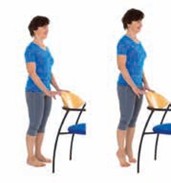
- Standing, with fingertips holding on for support.
- Raise on to your tip toes, tall as you can. Keep your knees straight throughout the movement and try not to sway forwards and backwards.
- Slowly lower heel back to the floor.
- Try to do three sets of five with 30 repetitions. Gradually build up how many you can do as the pain allows.
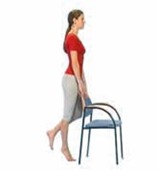
- Standing on a single leg, with fingertips holding on for support.
- Raise on to your tip toes, tall as you can. Keep your knees straight throughout the movement and try not to sway. Slowly lower heel back to the floor.
- Try to do three sets of five with 30 repetitions. Gradually build up how many you can do as the pain allows.
Only do this exercise after you have completed the first 2 levels and start gently. It can be sore to perform initially.
Two legs
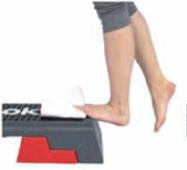
- Stand on two legs with the front of your foot on the edge of a step and a towel roll placed under the toes raising them up. Hold on to something stable to help your balance.
- Push up onto your toes, counting slowly to three and then hold for two seconds.
- Lower the heel towards the floor by counting to three and repeat from the beginning.
- Try to do three sets of five to fifteen repetitions. Gradually build up how many you can do as the pain allows.
One leg
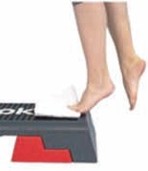
- Repeat the same exercise but this time stand tall on one leg, (the front of your foot on the edge of a step and a towel roll placed under the toes); repeat the exercise.
- Try to do three sets of five to fifteen repetitions. Gradually build up how many you can do as the pain allows.
Stretches
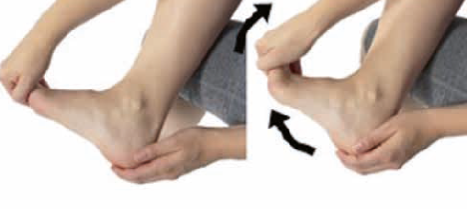
- Sit with your lower leg across your other knee.
- With your ankle bent, hold your heel with one hand and, using your other hand, pull your toes back towards your shin.
- Hold for 20 to 30 seconds, release and repeat three to five times.
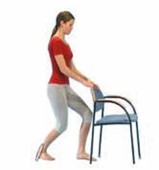
- Place the bad foot behind you, foot pointing straight ahead, keep the heel down and bend the knee to feel a stretch in the lower calf muscle.
- Hold for 20 to 30 seconds, release and repeat three to five times.
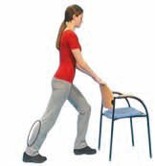
- Place the painful foot behind you, foot pointing straight ahead, keep the heel down and knee straight and lean forwards to feel a stretch in the calf muscle.
- Hold for 20 to 30 seconds, release and repeat three to five times.
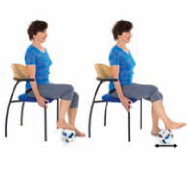
- Sitting, place a tennis ball, frozen bottle of water or tin of beans under your foot (be careful with a frozen bottle as not to get an ice burn).
- Roll it forwards and backwards under your foot by bending and straightening your knee.
- Do for this for two to 10 minutes.
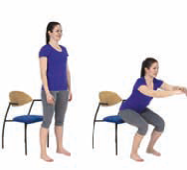
- Have your feet in a comfortable position, roughly as wide as your hips.
- Stand from a sitting position driving up through the heels. Keep the knees in alignment with the feet. If using a Theraband keep the band taught.
- Return slowly to a sitting position.
- Try to do three sets of between five and 30 repetitions. Gradually build up to as many as is tolerable.
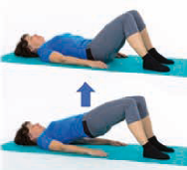
- Lie on your back with legs bent.
- Squeeze your buttock muscles and roll your pelvis off the floor.
- In a controlled manner, return to the starting position.
- Try to do three sets of between five and 30 repetitions. Gradually build up to as many as is tolerable.
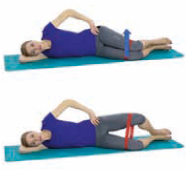
- Start in-side lying with your legs bent (place a band around your thighs, close to your knees if you want to make it harder).
- Lift and rotate the upper knee upwards. Keep your feet together and pelvis pointing straight forward. Feel the tension in your buttocks.
- Lower the leg back to the starting position.
- Try to do three sets of between five and 30 repetitions. Gradually build up to as many as is tolerable.
Your Health Notts
It is always important to consider other factors that can contribute to musculoskeletal problems and may limit your recovery. The most common factors that can affect your health and wellbeing include smoking, alcohol, weight, stress and general fitness.
There is an excellent resource now available to Nottinghamshire County residents that offers information and guidance on:
- Stopping smoking
- Losing weight
- Alcohol reduction
- Increasing physical activity.
Please visit the Your Health Notts website to find out more or self-refer to this service.
Further sources of information
This document is intended for information purposes only and should not replace advice that your relevant health professional would give you.
External websites may be referred to in specific cases. Any external websites are provided for your information and convenience. We cannot accept responsibility for the information found on them.
Patient Experience Team
The Patient Experience Team (PET) is available to help with any of your compliments, concerns or complaints, and will ensure a prompt and efficient service.
Contact Patient Experience.

Approved
October 2025
Review date
October 2027
Document Id
PIL202510-01-HP
Service / Department
Musculoskeletal (MSK)
Other formats
Patients who would like this information in an alternative format, or need help communicating with us, please contact our patient experience team.