Patient Information

Lateral hip pain (greater trochanteric pain syndrome)
Print this page

Information in this booklet is intended to be used as a guide. It gives you an idea about how lateral hip pain can be managed.
You should remember that every case is different, and symptoms and management can vary from person to person.
Lateral hip pain is a common condition causing pain over the outside or ‘lateral’ aspect of the hip region; often it spreads to the buttock, or runs down the outside of your thigh, down to the knee. It can flare up suddenly or build up over time.
It affects 10-25% of the population and is more common in females than males. Many people with lateral hip pain benefit from physiotherapy and a graded rehabilitation programme, which can take six to nine months.
What is lateral hip pain?
Lateral hip pain occurs when the soft tissues that attach to the top of the thigh bone become irritated. These soft tissues include muscles and tendons.
Recent studies suggest that the pain is most likely due to overloading, deterioration or irritation within the buttock muscles. This discomfort may have occurred for several reasons, but it is commonly due to a compression-type force applied to the tendons.
Additionally, the iliotibial band, commonly referred to as the ITB, is a thick strip of connective tissue which can also become irritated and cause pain on the outside of the thigh.
Sometimes the bursa can also contribute to symptoms. When this bursa is inflamed, this is called ‘bursitis’.
The bursa is a small sac filled with fluid; they are all over the body and sit between tendons and bones. The one that sits on the outer aspect of the hip is called the trochanteric bursa; when its inflamed it is called trochanteric bursitis.
Tendons are good at absorbing load as long as it is steady and regular. If the force differs, it can lead to changes in the tendon resulting in pain around the outside of the hip and down the outside of the thigh. When tendons are compressed or disturbed it can cause inflammation. This is known as ‘tendinopathy’.
Why me?
There are some risk factors that make lateral hip pain more likely:
It is more prevalent in females.
Patients tend to be aged between 30 and 60.
Female patients may be peri or post- menopausal who might have put on weight, have a less active lifestyle or have become involved in more vigorous exercise than they are used to.
Patients who start new exercise or activities and increase the load and/or intensity.
If you have weak gluteal (buttock) muscles or tight adductors.
Trauma to the hip area, such as a fall.
Prolonged standing, sitting or lying with excessive pressure on the hip joint.
Scoliosis or leg length difference.
Being overweight, smoking or poor control of diabetes.
Symptoms
Lateral hip pain is normally felt down the outside of your hip and/or buttock; this can also spread down the outside of the thigh to the knee.
If you also complain of lower back pain at the same time, it suggests that the lateral hip pain is being referred from the lumbar spine (lower back). They can range from very mild to more intense symptoms and can include:
Standing on one leg or with one side of your hip dropping to the floor (‘hip hang’).
Walking, especially up and/or down hills or stairs.
Sitting - knees together, legs crossed, or feet tucked underneath you.
Lying on the affected side (and sometimes on the other side).
When getting in and out of a car or a bath, etc.
Doing prolonged and/or repeated physical activities.
Diagnosis and investigations
Lateral hip pain is diagnosed from the signs and symptoms that you describe. Assessment of the hip, lower back and knee by a health care professional helps to inform this diagnosis. If the diagnosis is unclear, then an x-ray or ultrasound can be performed to aid the diagnosis.
Will it get better?
Your symptoms can often be managed with advice and exercises from the physiotherapist.
Most cases will resolve with conservative (non-surgical) treatment within six to 12 months with focused rehabilitation.
It is normal to have periods of increased pain or flare-ups during this time. If this happens, you may need to reduce your exercises until the pain returns to previous levels.
Treatment is aimed at:
Reducing pain and inflammation and promoting healing.
Restoring flexibility and normal movement.
Improving and normalising function.
We work with a team of orthopaedic advanced practitioners and consultants. If you do not respond to physiotherapy, we can escalate your care, such as considering steroid injections.
Steroid injections are sometimes used to facilitate physiotherapy exercises. They offer a window of opportunity of reduction in symptoms to allow participation in the exercises. Injections are only offered alongside physiotherapy.
Surgery for lateral hip pain is rare.
Management
Lateral hip pain is treated with a variety of different management techniques. Below is a list of ways you can help yourself.
Advice and education.
Home exercise programme.
Pain control.
Rest: Try to reduce where possible any activity that is aggravating the hip.
Strength: Strengthen your lower back and legs. It is important that these exercises are performed relatively pain-free (discomfort is expected) and achieve an element of 'fatigue'.
Ice / heat: This is specific to each individual. Depending on the structure you may find benefit more from one or the other to help manage the pain.
Activity: Activity modification and gradual return to full activity as pain improves.
Other factors: Try to identify any changes in your lifestyle and consider if they could have occurred at the same time as the onset of your problem. If so, try reversing this to see what effect it has on your pain.
Medication for pain control
Controlling your pain allows you to continue to function and carry out your daily activities more comfortably.
Your GP may have already discussed medication to help with your pain and the correct ways to take pain relief. They may recommend that you take it as a short course rather than ‘as and when’ the pain is bad. This often includes paracetamol, co-codamol (Zapain), and non-steroidal anti-inflammatory medication such as ibuprofen. Please always read the instructions before using these products.
Steroid injections
Steroid injections are sometimes used to facilitate physiotherapy exercises. They are not suitable for every patient. However, for lateral hip pain, they only provide short-term pain relief, with the long-term effectiveness being poor. Therefore, they offer a window of opportunity for a reduction in symptoms, to allow participation in the exercises.
Injections are only offered alongside physiotherapy. There are risks with soft tissue injections and these should be discussed with your healthcare professional.
Surgery
In some chronic severe cases, surgery may be required, but this is a last resort. It is only when physiotherapy or other non-surgical techniques have not worked.
Advice and education
This condition can be affected by the movement patterns that we adopt in daily life. It is very important that we change these patterns in order to reduce the compression on the tendon to allow it to heal. By reducing the frequency and length of time that you do these movements, this will help to reduce the symptoms that you are feeling from the tendons.
Try to avoid:
Sitting in low or saggy chairs, with your legs crossed or knees wide apart – keep your knees and hips parallel. A wedge cushion may make sitting more comfortable.
Sitting longer than 30 minutes, get up and move about.
Lying on your sides in bed. Try sleeping on your back or on your sides with a pillow or two between your knees to keep your thighs parallel.
Standing with your hip to one side. Stand with your feet hip-width apart.
Try to keep as active as your pain allows, modify activities or use aids if needed. Use a stick or poles when walking and handrails on stairs.
Reduce repetition, load and distance on exercises or physical activities as required, as this will help with healing.
Exercises
Lateral hip pain is most often related to hip structures not coping with heavy and frequent loads.
Therefore, exercises to strengthen this area will help with healing and to return to normal activity. Below are some exercises to do in the early stage of your rehabilitation.
Your physiotherapist may identify other specific exercises for you to complete as you progress. You should follow the instructions and monitor your performance of these carefully. Load is needed to aid recovery, but overload may increase your pain, balance is important. For example, a mild ache during and for a short period afterwards is expected, but stop if pain becomes unmanageable or long-lasting.
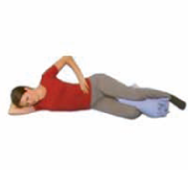
- Place one or two pillows between your legs. Painful leg on top.
- Place your hand on your top thigh mid-way down (indicated by the arrow).
- Gently push your top leg up and resist with your hand so your leg muscles tighten but the leg does not lift off the pillow.
- Hold for five to fifteen seconds, repeat five to10 times, twice a day.
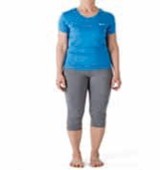
- Stand with your feet flat on the floor, with feet slightly wider than hip width apart. Imagine you are pushing your legs apart as if going to do the splits. Your feet will remain in the same position. You will feel the muscles on the outsides of your thighs, knees and bottom tighten. Your knees may rotate outwards a small amount.
- Hold for five to fifteen seconds, repeat five to 10 times, twice a day.
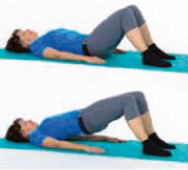
- Lie on your back with legs bent on the floor or on your bed.
- Squeeze your buttock muscles and slowly lift your buttocks off the bed or floor a small amount and in a controlled manner.
- Hold this position and then return to the start position.
- Hold for five to fifteen seconds, repeat five to 10 times, twice a day.
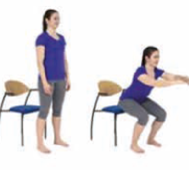
- Stand in front of a chair, squat down as if you were sitting down, sticking your bottom out.
- Briefly touch the chair with your bottom and then stand back up (squeezing through your buttock muscles and pushing down through your heels). Make sure you maintain the gap between your knees throughout the entire movement. Avoid your knees falling inwards.
- You may wish to hold onto a support when you first begin this exercise.
- Repeat five to fifteen times, two to three times per day.
Your Health Notts
It is always important to consider other factors that can contribute to musculoskeletal problems and may limit your recovery. The most common factors that can affect your health and wellbeing include smoking, alcohol, weight, stress and general fitness.
There is an excellent resource now available to Nottinghamshire County residents that offers information and guidance on:
- Stopping smoking
- Losing weight
- Alcohol reduction
- Increasing physical activity.
Please visit the Your Health Notts website to find out more or self-refer to this service.
Further sources of information
This document is intended for information purposes only and should not replace advice that your relevant health professional would give you.
External websites may be referred to in specific cases. Any external websites are provided for your information and convenience. We cannot accept responsibility for the information found on them.
Patient Experience Team
The Patient Experience Team (PET) is available to help with any of your compliments, concerns or complaints, and will ensure a prompt and efficient service.
Contact Patient Experience.
Approved
October 2025
Review date
October 2027
Document Id
PIL202510-01-LHP
Service / Department
Musculoskeletal (MSK)
Other formats
Patients who would like this information in an alternative format, or need help communicating with us, please contact our patient experience team.