Patient Information

Lower back and leg pain
Print this page

Information in this booklet is intended to be used as a guide. It gives you an idea about how lower back and leg pain can be managed.
You should remember that every case is different, and symptoms and management can vary from person to person.
Sprains and strains of the back can cause ‘mechanical lower back pain’ and can sometimes refer pain and symptoms down the leg. Pain travelling down the leg from the back can be caused by stiffness and inflammation of joints in the lower back, or irritation of nerves.
It is important to understand that structural irritations are not the only causes or factors that can contribute to back and leg pain; these can include, poor health and wellbeing, understanding the impact of attitudes and beliefs of pain, poor sleep. Addressing these will help with pain and symptom management.
Your healthcare professional will be able to perform a thorough assessment to gain a better understanding of your condition and the management options that will help you to achieve your personal goals.
In most cases, MRI scans are not needed to make a diagnosis. Your healthcare professional can discuss if a scan is needed. Scans often report things such as disc bulges; these are common findings in a lot of people with or without pain or symptoms. Scans do not predict how much pain you feel or indicate how well you will respond to treatment. If you have had a scan, ask your healthcare professional to talk through the report with you to help you understand the findings.
Lower back and leg pain will normally get better over time. This booklet contains information about different treatments that are available. Your healthcare professional can explain your treatment options with you further.
What is lower back and leg pain?
Mechanical back pain, sprains and strains of the lower back can result in pain referring from the back and travelling down the leg. Pain travelling down the leg from the back can be also be caused by stiffness and inflammation of joints, or irritation of nerves.
These nerves can become irritated for several reasons that may include stiffness of the joints, tension in the muscles, and/or a disc bulge(s).
When the nerve is irritated, it can cause pain, a tingling ‘pins and needles’ sensation, numbness and/or weakness. The level of nerve irritation, or how your body responds, may mean your leg pain presents differently.
Why me?
There may or may not be a specific reason or cause for your pain. It is thought that lower back and leg pain is more common in people who:
Are not physically active.
Are obese.
Are under emotional or physical stress.
Perform an activity that they are not used to.
Do not sleep well.
Smoke.
Your healthcare professional will ask you questions, which will help to determine what management approach is most suitable for you.
Symptoms
People with lower back and leg pain typically complain of a ‘toothache’ type pain or sharp pain in the lower back.
Patients often refer to this area as the hip. You can get lower back pain with or without leg pain. Lower back and leg pain can come with other symptoms such as tingling, numbness and/or weakness in one or both legs.
There are usually certain movements that make your pain feel worse; these will vary between patients. Once you move out of this position, your pain may improve in minutes or hours.
Is it serious?
Lower back and leg pain is a very common issue, it can be painful and cause you to struggle with your normal activities, but it is not usually serious or an emergency.
Cauda Equina syndrome and spinal myelopathy symptoms
These are rare conditions where the spinal cord gets compressed. If you have, or start to get, any symptoms listed below, you should seek urgent medical attention via an Emergency Department (A&E):
Problems going to the toilet, including a new feeling of wanting to empty your bladder but being unable to, continuation of emptying your bladder when you thought you had finished, or incontinence of bladder or bowels.
Tingling or numbness in your genitals, back passage (anus) or upper, inner thighs.
Large reduction in strength and/or coordination of arms and hands, and/or legs.
Unexplained balance problems or unsteadiness in your legs.
Diagnosis and investigations
Lower back and leg pain is diagnosed from the signs and symptoms that you describe.
Assessment of the lumbar spine and nerve function by a healthcare professional may help to inform this diagnosis. If the diagnosis is unclear or injections are being considered, an MRI scan of the lumbar spine may be arranged. This is aimed at looking at the ‘nerve roots’; however, there is often not a strong link between the severity of changes seen on an MRI and the amount of pain you are in.
Will it get better?
Lower back and leg pain often gets better on its own, with time.
In most cases, pain relief from your GP and physiotherapy is the first line of recovery, not treatment. Physiotherapists offer advice, education, exercises, and in some cases, hands-on therapy to help with your symptoms.
Regaining your normal movement is important to help ease your symptoms. For most people, the pain does not come back, however, for others it might. Investigations/imaging, such as an x-ray or MRI, are not normally indicated or needed with mechanical lower back pain. This is because it is unlikely to change your management.
Management
Below are further ways that may help you in the management of your lower back and leg pain:
Keep active
Try to keep as active as possible, with your normal activities or exercise. Being generally active will help to keep your body moving and reduce any stiffness.
Normal movement, exercise and activity will not cause harm if you work within manageable pain levels. If you can work, do some hobbies and be physically active on some level, you are more likely to get better sooner.
If you don’t currently do any general exercise, it would be helpful to consider starting something gentle and build on it slowly as you feel more confident. If you have any other conditions that limit your ability to exercise, please discuss this with your health professional.
Medication for pain control
Controlling your pain allows you to continue to function and carry out your daily activities more comfortably.
Your GP may have already discussed medication to help with your pain and the correct ways to take pain relief. They may recommend that you take it as a short course rather than ‘as and when’ the pain is bad. This often includes paracetamol, co-codamol (Zapain), and non-steroidal anti-inflammatory medication such as ibuprofen. Please always read the instructions before using these products.
Other pain control options
Some people may find relief with heat or ice packs, gels or a TENS machine. These may be helpful in the short-term and help you with physiotherapy exercises.
Pacing
Whilst the pain is limiting your activities it is important to find a balance between doing too little, or too much, of what is causing you pain. This is a balancing act and it is called pacing.
Take regular breaks from activities that trigger your pain and do other activities that are less bothersome. This is an important part of helping yourself during this time. As your symptoms settle you will find you can start doing a little bit more.
Advice
There is a link between stress, anxiety and depression and ongoing back and leg pain, so you may find it useful to address these if they affect you. Research shows exercise, relaxation and/or social activities can help reduce stress.
There is a link between poor sleep and ongoing pain. You may find it useful to address this if it affects you. The NHS website has useful links on how to get a good night's sleep.
Quitting smoking and reducing your alcohol intake will also help improve your symptoms.
Further management
Do not worry if you do not see improvements straight away – remember, time is often a very important factor.
Some people with lower back and leg pain may be referred to a pain clinic where additional management strategies, alongside physiotherapy may be discussed with you.
Spinal surgery is not normally indicated or helpful for lower back and leg pain. In very rare cases, and where all other treatments have not worked, we will refer you to specialist services who can review your case.
Exercises
Whether its a new episode of lower back pain or a pain that has been around for a while, people can find it helpful to start with some gentle exercises. Evidence shows exercise in many forms will help lower back pain, increase mobility and improve functional ability. Some exercises are to improve movement and ‘looseness’, others are to improve strength.
Exercises to improve movement can be done little and often throughout the day. With time and practice, these can make you feel looser and move more easily. They may make you feel sore at first, but this is okay and will not be damaging. It will help to stretch and move muscles, tendons and nerves. You can practice for just a few seconds or a few minutes – both approaches work.
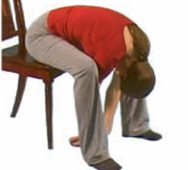
- Sit with your feet firmly on the floor with your knees slightly wider than your shoulders.
- Round your back and bend forward keeping your neck and shoulders relaxed.
- Repeat the above five to 10 times, or until you feel a bit looser.
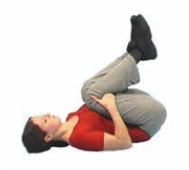
- Lie with your knees bent and feet on the floor.
- Lift your knees towards your chest.
- Place your hands behind both knees and pull them towards your chest.
- You can choose when to practice; people often try little and often throughout the day or in the morning and evening.
Gentle exercises
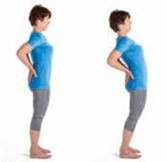
- Standing with your feet hip width apart place your palms on your lower back above your buttocks on your lower back.
- Open your chest and lean backwards.
- Return to the starting position.
- Repeat five to ten times.
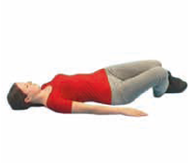
- Lie on your back with your knees together and bent with your arms by your side.
- Slowly roll your knees from side to side while keeping your upper body still.
- You can choose when to practice; people often try little and often throughout the day or in the morning and evening.
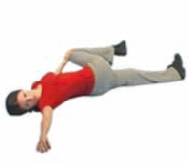
- Lie on your back with your legs straight along the floor.
- Using the opposite arm, bring one knee up to your chest.
- Pull this knee over and up towards the shoulder of the arm you’re using.
- You should feel a stretch in your buttock and lower back.
- Hold this position for 20 seconds and repeat on the opposite leg.
- Repeat the above three times on each leg.
Strength exercises
Exercises to improve strength and endurance are best practiced once per day or even a few times over the week. These will make the lower back feel sore; this is completely normal and you will adapt with time.
These will normally only take a minute or two, and it will be normal to feel tired for a short time afterwards.
You can try one set of five repetitions and then build up gradually. With practice, you will find these exercises get easier and adding a few more repetitions will increase the challenge.
Some people end up doing too much on a good day and too little on a bad day. It is better to be consistent. It will take some time to become better at this.
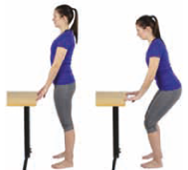
- Holding onto a table or other flat surface and standing upright, place your feet hip width apart.
- Pointing your toes out slightly, bend your knees and stick your bottom backwards, keeping your chest up and your eyes facing forwards.
- Return to the upright position.
- Repeat the above five to 10 times.
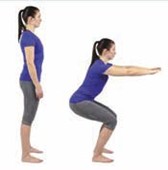
- Stand tall with feet slightly wider than hip- width apart.
- Squat down by sitting back and bring your arms forward.
- Start with a few repetitions and gradually increase; only one set per day is needed.
Other exercises, such as regular walking, cycling and squats are also strongly advised.
Your Health Notts
It is always important to consider other factors that can contribute to musculoskeletal problems and may limit your recovery. The most common factors that can affect your health and wellbeing include smoking, alcohol, weight, stress and general fitness.
There is an excellent resource now available to Nottinghamshire County residents that offers information and guidance on:
- Stopping smoking
- Losing weight
- Alcohol reduction
- Increasing physical activity.
Please visit the Your Health Notts website to find out more or self-refer to this service.
Further sources of information
This document is intended for information purposes only and should not replace advice that your relevant health professional would give you.
External websites may be referred to in specific cases. Any external websites are provided for your information and convenience. We cannot accept responsibility for the information found on them.
Patient Experience Team
The Patient Experience Team (PET) is available to help with any of your compliments, concerns or complaints, and will ensure a prompt and efficient service.
Contact Patient Experience.
Approved
October 2025
Review date
October 2027
Document Id
PIL202510-01-LBL
Service / Department
Musculoskeletal (MSK)
Other formats
Patients who would like this information in an alternative format, or need help communicating with us, please contact our patient experience team.