Patient Information

Tennis elbow
Print this page

Information in this booklet is intended to be used as a guide. It gives you an idea about how tennis elbow can be managed.
You should remember that every case is different, and symptoms and management can vary from person to person.
Tennis elbow (lateral epicondylitis/lateral epicondyle pain) is a condition that causes pain around the outside of the elbow.
It usually affects the dominant arm, and often occurs after overuse of the forearm muscles and tendons near the elbow. This results in inflammation in the tendon, which is also known as tendinopathy.
What is tennis elbow?
Tennis elbow is an overuse injury. It occurs when the muscles in the forearm are strained due to repetitive, strenuous or overload activity.
Tennis elbow is sometimes caused by racket sports such as tennis, but it is more often caused by other activities that put repeated stress on the tendon, such as decorating, manual work or throwing activities. However, anyone can suffer from tennis elbow without doing these specific activities.
Why me?
Tennis elbow is a common musculoskeletal condition. It affects between 1% to 3% of the population, and five in every 1000 people see their GP about tennis elbow each year.
The condition affects men and women equally and is more common in people between the ages of 40 and 60 years.
Symptoms
Tennis elbow causes pain and tenderness on the outside of your elbow. You may also have pain down into your forearm.
Symptoms can range from mild discomfort to severe pain; they can be present when using your arm or at rest.
The pain is often worse when you use your arm; repetitive wrist movements, such as flexing or extending your wrist and gripping, can also make the pain worse.
If you have tennis elbow, you will usually experience:
Pain on the outside of your upper forearm, just below your elbow.
Pain may travel down towards the wrist.
Pain when lifting or bending your arm.
Pain when writing or gripping.
Pain when twisting your forearm, such as turning a door handle or opening a jar.
Pain and stiffness when fully extending your arm.
Diagnosis and investigations
Tennis elbow is diagnosed from the signs and symptoms that you describe. Assessment of the elbow and wrist by a healthcare professional may help to inform the diagnosis.
If the diagnosis is unclear, then an x-ray or ultrasound can be performed to aid the diagnosis.
Will it get better?
Your symptoms can often be managed with advice and exercises from your physiotherapist.
Most cases will resolve with conservative treatment within six to 12 months. Most people make a full recovery if they follow the management plan. Sometimes, symptoms can return in the future.
Treatment is aimed at:
Reducing pain and inflammation, and promoting healing.
Restoring flexibility and normal movement.
Improving and normalising function.
Changing the tendon loading.
We work with a team of advanced clinical practitioners and orthopaedic consultants who can review your case if symptoms do not improve within an expected period of time.
Management
Your healthcare professional can provide you with exercises to help strengthen the forearm tendons and muscles and give you individual advice on managing your condition.
Treatment aims to alter how load is put through the tendon to offload it, allowing the inflammation to settle.
The use of braces or strapping, such as an epicondylitis clasp, may be recommended in the short term for pain relief.
Tennis elbow is treated with a variety of management techniques. Below is a list of ways you can help yourself:
Modify or reduce activities that aggravate the pain.
Take over-the-counter pain relief.
Use cold therapy, such as a bag of frozen peas wrapped in a towel.
Medication for pain control
Controlling your pain allows you to continue to function and carry out your daily activities more comfortably.
Your GP may have already discussed medication to help with your pain and the correct ways to take pain relief. They may recommend that you take it as a short course rather than ‘as and when’ the pain is bad. This often includes paracetamol, co-codamol (Zapain), and non-steroidal anti-inflammatory medication such as ibuprofen. Please always read the instructions before using these products.
Treatment
Activity modification. Modify or reduce activities that aggravate the pain, such as lifting.
Medication. Taking pain relief, such as over-the-counter paracetamol or ibuprofen, can help manage the pain. It is more effective to take it regularly rather than only when the pain is bad.
Ice/heat. This is specific to each individual. Depending on the structure that is affected, you may find more benefit from one or the other to help manage the pain
Physiotherapy. See the exercises further on in the leaflet.
Steroid injections
Steroid injections are sometimes used to facilitate physiotherapy exercises. However, for tennis elbow, they only provide short-term pain relief with limited long-term benefit. Therefore, they offer a window of opportunity for a reduction in symptoms, to allow participation in the exercises.
Injections are only offered in conjunction with physiotherapy. There are risks with soft tissue injections, and these should be discussed with your healthcare professional.
Platelet rich plasma injections (PRP)
PRP is a treatment where blood plasma containing concentrated platelets is injected into the elbow to help repair the affected tissue. It has been shown to help speed up the healing process, but its long-term effectiveness is unknown. You would need to be referred to orthopaedics to discuss whether this treatment is appropriate for you.
Do I need surgery?
In some chronic severe cases, surgery may be required, but this is a last resort. It is only considered when physiotherapy or other non-surgical techniques have not worked. Surgery does not always resolve your pain.
Exercises
The following exercise programme has been designed for patients with rotator cuff tears. It will help to build up the strength of the muscles around your shoulder, which should improve their function.
The exercises should be done two to three times a day, for at least 12 weeks. Start the exercises lying down to begin with; as strength increases, move to an inclined sitting position, then to full sitting and finally to a standing position.
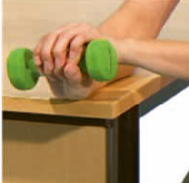
Seated or standing, support your forearm on a table with your palm facing down.
Hold a small weight, such as a dumbbell, food tin, bottle or hammer.
Bend your wrist up against gravity. Hold for one to two seconds and then slowly lower down.
Repeat the above eight to 12 times for a total of three sets, resting for one to two minutes in between sets.
Complete the exercise once or twice per day.
This exercise should provide nothing more than a mild discomfort that settles within one to two hours.
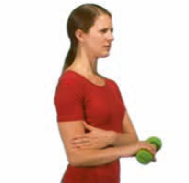
Stand with your elbow bent at 90 degrees to your body and your hand pointed in front of you.
With your palm turned up and holding a small weight, such as a dumbbell, food tin, bottle or hammer, rotate your forearm so your palm ends up facing downwards (keeping your elbow at 90 degrees to your body).
Rotate your forearm to bring your palm back to facing up.
Repeat the above eight to 12 times for a total of three sets, resting for one to two minutes in between sets.
Complete the exercise between one and two times per day.
This exercise should provide nothing more than a mild discomfort that settles within one to two hours.
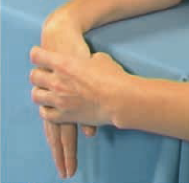
Seated or standing, support your forearm on a table with your hand over the edge and palm facing down.
Let your hand drop down over the table.
Using your other hand, gently stretch your hand to point your fingers to the floor, feeling a stretch in the uppermost part of the forearm.
You can increase the stretch by curling your fingers into a loose fist.
Hold the position for 20 seconds.
Repeat the exercise two to three times per day.
This exercise should provide nothing more than a mild discomfort that settles within one to two hours.
Your Health Notts
It is always important to consider other factors that can contribute to musculoskeletal problems and may limit your recovery. The most common factors that can affect your health and wellbeing include smoking, alcohol, weight, stress and general fitness.
There is an excellent resource now available to Nottinghamshire County residents that offers information and guidance on:
- Stopping smoking
- Losing weight
- Alcohol reduction
- Increasing physical activity.
Please visit the Your Health Notts website to find out more or self-refer to this service.
Further sources of information
This document is intended for information purposes only and should not replace advice that your relevant health professional would give you.
External websites may be referred to in specific cases. Any external websites are provided for your information and convenience. We cannot accept responsibility for the information found on them.
Patient Experience Team
The Patient Experience Team (PET) is available to help with any of your compliments, concerns or complaints, and will ensure a prompt and efficient service.
Contact Patient Experience.
Approved
October 2025
Review date
October 2027
Document Id
PIL202510-01-TENE
Service / Department
Musculoskeletal (MSK)
Other formats
Patients who would like this information in an alternative format, or need help communicating with us, please contact our patient experience team.